

Researchers say they have discovered the first nearby “super-Earth” planet that could possibly support life.
The discovery was made by a spacecraft designed to look for planets outside of our solar system. An international team of astronomersrecently announcedtheir findings in the publicationAstronomy & Astrophysics.
The new discovery is known as anexoplanet, a planet that orbits a star outside of our own solar system. Exoplanets are not easy to identify with telescopes. This is because they are often hidden by the bright light of the stars they orbit.
In an effort to help discover such planets, NASAlaunchedits Transiting Exoplanet Survey Satellite, or TESS, last year. TESS was designed to expand upon the work of previous exoplanet discoveries made with telescopes. More than 3,500 newexoplanetshave been discovered over the past 20 years.
What is a super-Earth?
A super-Earth is a planet that has a mass between one and 10 times that of Earth. The team of astronomers says the newly-discovered exoplanet – called GJ 357 d - is about 31light-yearsaway from our solar system. The planet orbits a star named GJ 357.
NASAsaidin an announcement that the planet appears to orbit within its star’s “habitablezone.”
A leading member of the research team was Diana Kossakowski from theMax Planck Institute for Astronomyin Heidelberg, Germany. She said in a statement that GJ 357 d should be receiving about the same amount of energy from its star as Mars does from the sun.
“If the planet has a dense atmosphere, which will take future studies todetermine, it could trap enough heat to warm the planet and allow liquid water on its surface,” Kossakowski said.
NASA says the planet’s mass is at least 6.1 times Earth’s and it orbits its star every 55.7 days.
Lisa Kalteneggeris an associate professor at New York’s Cornell University. She is also a member of the TESS science team. Kaltenegger called the new discovery “exciting.”
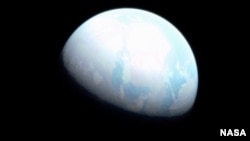
“This is TESS’s first discovery of a nearby super-Earth that couldharborlife,” shetoldthe university’sCornell Chronicle. “TESS is a small, mighty mission with a huge reach,” she said.
Kaltenegger added that the discovery will provide valuable information about this and other large exoplanets outside our solar system. “With a thick atmosphere, the planet GJ 357 d couldmaintainliquid water on its surface like Earth, and we could pick out signs of life with telescopes that will soon be online,” she said.
NASA says TESS observed the GJ 357 star system last February. Researchers estimated the star is about one-third the mass of our sun. Several other exoplanetswere discoveredin the system after being caught by TESS cameras.
One of those exoplanets was identified as GJ 357 b, a planet 22 percent larger than Earth, the astronomers reported. It orbits 11 times closer to its star than Mercury does to our sun. GJ 357 b is thought to have surface temperatures up to 254 degrees Celsius.
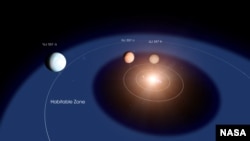
GJ 357 b is considered a “hot Earth,” said Enric Pallé, a lead member of the discovery team with theInstitute of Astrophysics of the Canary Islands.
Pallé noted that the planet could not hold life. But it is “one of the best rocky planets we have for measuring thecompositionof any atmosphere it maypossess,” he added.
Jack Madden is a student at Cornell University who helped with the research on GJ 357. He says the new discoveries have opened the door for astronomers to test theories and models about exoplanets.
“We built the first models of what this new world could be like,” Madden said. “Just knowing that liquid water could exist on the surface of this planetmotivatesscientists to find ways ofdetectingsigns of life.”
I’m Bryan Lynn.
Bryan Lynn wrote this story for VOA Learning English, based on reports from NASA, Cornell University and the Institute of Astrophysics of the Canary Islands. Mario Ritter Jr. was the editor.
We want to hear from you. Write to us in the Comments section, andvisit our Facebook page.
Quiz - NASA Satellite Discovers ‘First Nearby Super-Earth’
Start the Quiz to find out
_______________________________________________________________
Words in This Story
habitable–adj.able to be lived in
light-year–n. (unit of measure)the distance light travels in one year
determine–v.discover the facts or truth about something
harbor–v.to be the home or habitat of
maintain–v.make a situation or activity continue
composition–n.the parts that something consists of
possess–v.to have or own something
motivate–v.to cause someone to behave a particular way
detect–v.to discover or notice something
Read More
No comments:
Post a Comment